How to Measure Doorways and Staircases Before Moving Large Furniture
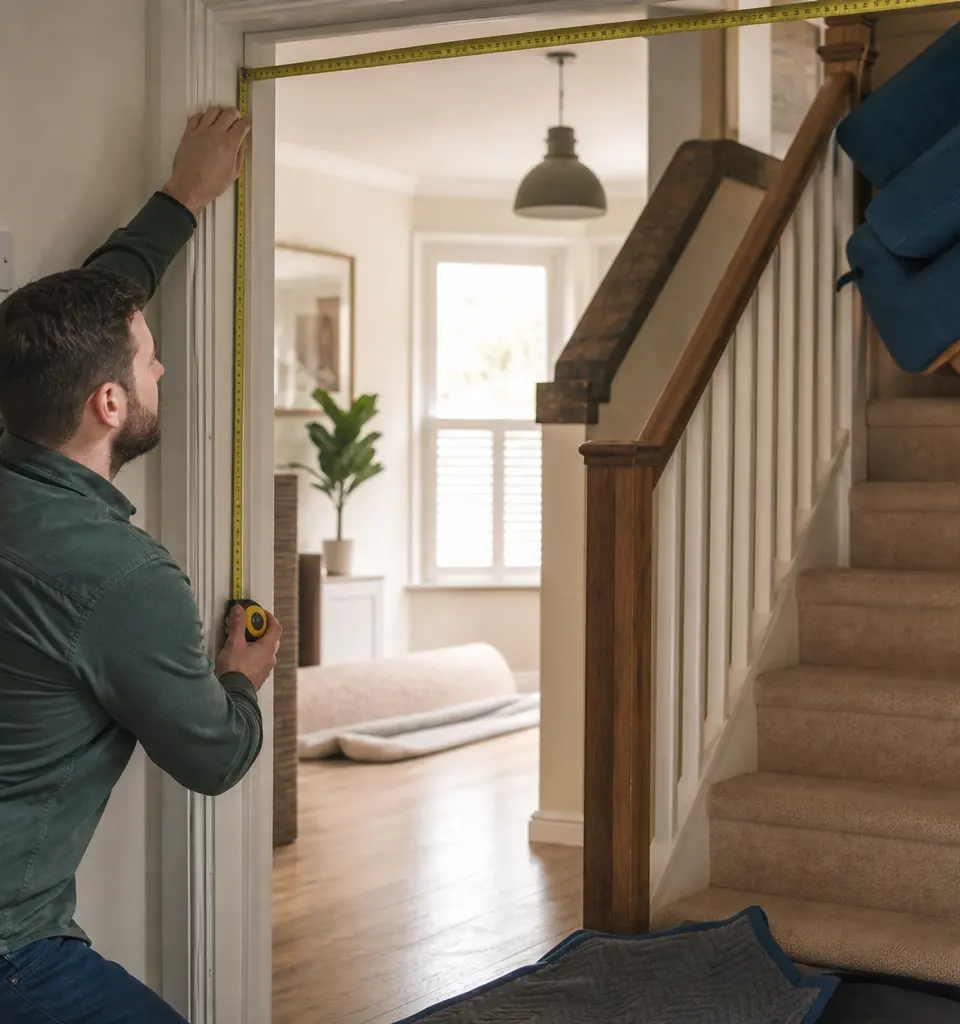
If you need to measure furniture doorways moving large items in London, start with a systematic check of every squeeze point: door frames, internal doors, corridors, stairwells, landings and lift dimensions. This guide explains the simple measurements and checks to make, how to interpret them for awkward shapes or turns, what can be removed or adjusted, and the information to give Budget Moves when you ask for a quote.
Why measuring matters before a move
Large furniture that looks like it will fit on paper often gets stuck because a critical measurement was missed: an architrave that adds 25mm, a narrow landing, a low ceiling on the stairs or a tight 90° turn. Measuring in advance avoids wasted time, unexpected extra costs and the need for on-the-day disassembly or alternate transport arrangements.
Tools you will need
- Tape measure (2–8 metres) — a retractable metal tape is best for accuracy.
- Folding rule or laser distance measurer for longer runs.
- Spirit level or straightedge to check for bulging walls or door frames.
- Pen and paper or a phone camera to record measurements and photos.
- Masking tape or chalk to mark reference points if testing at home.
Basic measurements to take (step-by-step)
Work from outside in: measure the route you will use from the vehicle or entrance to the final room. For each doorway, corridor and stairwell record the following.
1. Doorway width and height
- Measure the clear opening width from the inside of one door frame to the other — do this at the top, middle and bottom. Use the smallest of these measurements.
- Measure the clear height from floor to the underside of the lintel at left, centre and right. Again, use the smallest value.
- Note whether the door is single or double leaf, and whether sills, thresholds or step-ups reduce the effective height or width.
2. Architrave, hinges and door swing
Architrave and hinges can reduce the available width. Measure to the face of the architrave and, if possible, measure from the jamb with the door open. Record which way the door swings — into the room or out — because a door removed or swung differently may free crucial centimetres.
3. Staircase width, rise and headroom
- Width: measure across the usable tread width at the narrowest point, not including any banister overhang.
- Headroom: measure from the tread nosing (where your foot sits) vertically to the ceiling directly above the line you will carry the furniture. Do this at several points along the route and use the minimum.
- Turn and landing sizes: measure the landing length and width, plus the angle of any intermediate turns. Measure width across the narrowest point of the turn.
4. Corridors and lift measurements
For corridors, measure the width and any projecting elements (radiators, cupboards). For lifts, note internal cabin width, depth and door opening width, and whether there are handrails that reduce usable space.
5. Furniture measurements to record
Measure furniture in three dimensions and note whether items can be turned or disassembled:
- Total height, width and depth.
- Diagonal measurement (corner to opposite corner) — critical for getting sofas around corners or through angled spaces.
- Weight estimate and whether legs or detachable parts can be removed.
How to use diagonal and angle measurements
Straight width and height are not always enough. For long items you may need the diagonal clearance — for example, angling a wardrobe when moving it through a door. To measure the diagonal:
- Measure the furniture's diagonal by placing the tape from one lower corner to the opposite top corner.
- Compare that diagonal with the clear door diagonal: measure the distance from the inner corner of the door jamb to the top opposite corner of the opening.
- If the furniture diagonal is less than the door diagonal and there is adequate headroom, the piece may pass when angled.
For turns on staircases, small angle differences matter. A long, narrow item may require more space to pivot on a landing than a short item — measure landing length and account for the clearance needed to rotate the item.
Common problems and simple solutions
Problem: Narrow doorways
Solution options include removing the door leaf (often a simple job to unscrew hinges or lift off the pins), stripping off skirting or architrave if non-structural, or disassembling the furniture (legs, arms, backs) where possible. If none of these work, you may need to use a window or balcony with specialist lifting equipment; discuss this with Budget Moves in advance.
Problem: Low headroom on stairs
Solution options include angling the item differently, removing ceiling-mounted fixtures, or taking the item apart. For very large items, professional removal teams can advise whether a stair carry is feasible or if alternate handling is required.
Problem: Tight 90° turns on stairs
Solution options include temporarily removing banister spindles or sections (where safe and permitted), lifting through a window, or dismantling the furniture into manageable sections.
What can usually be removed safely
- Door leaves — often removable by lifting off hinge pins or unscrewing strap hinges.
- Sofa legs or small bolts on chairs and tables.
- Removable shelves from wardrobes or bookcases to reduce width and weight.
- Loose radiators covers, small fixtures or light fittings (only if doing so does not affect wiring/plumbing).
If you are unsure whether an item can be dismantled without damage, ask Budget Moves in your quote request — include photos and measurements.
Recording and sharing measurements for a removal quote
When asking Budget Moves for a quote, include:
- Clear measurements of the item(s): height, width, depth and diagonal.
- Measurements of the route: door widths and heights, stair widths and headroom, landing sizes, and lift dimensions (if applicable).
- Photos from multiple angles showing doors, stairs and any obstructions. A short video walking the route is even better.
- Notes on what can be removed from the item (legs, drawers, shelves) and any fragile or built-in elements.
Providing full details reduces the chance of an on-the-day issue and helps Budget Moves plan the right crew, tools and vehicle for your job. Use our online form to share photos and measurements when you request a quote: Get a quote.
Tips for measuring like a pro
- Always take the smallest measurement for width/height — structures can be uneven.
- Measure at multiple heights and points — architraves and sills change the clear opening.
- Use the diagonal method for sofas and long items; it often reveals extra clearance.
- Mark and photograph any potential snags such as protruding radiators or light fittings.
- Leave a margin of 20–40mm when planning — tapes and angles add uncertainty.
Special notes for common items
Sofas
Measure seat depth, back height and width between arms. If a sofa is modular or has removable feet/legs, note that. Many sofas can be tilted, but check headroom on stairs to avoid catching the ceiling.
Wardrobes and tall cupboards
These are often easiest to move when empty and with doors or shelves removed. Measure diagonal and consider whether the top can be unbolted from the base.
White goods and appliances
Note both physical size and the need for upright handling. For freezers and fridges, confirm whether the item can lay on its side (manufacturer advice applies) and include weight estimates for safe handling.
When to call in a professional
If any of the following apply, get professional advice before moving day:
- Very large, heavy or awkward items (pianos, large wardrobes, bulky antiques).
- Items that may require window lifts or crane-assisted removal.
- Properties with narrow staircases, low headroom or listed features where disturbance is restricted.
Budget Moves arranges and provides removal services across London. The owner personally carries out selected moves and arranges or subcontracts additional work through suitable removal professionals depending on the job and availability. When you contact us, include your measurements and photos so we can advise whether disassembly, specialist equipment or an alternative route will be necessary.
On the day: safe handling and protection
Use protective covers for floors and furniture, protective corners for delicate edges, and straps or trolleys for heavy items. Ensure hallways and staircases are clear of rugs and trip hazards. If you are moving items yourself, get help with the heaviest lifts and use good manual handling technique to avoid injury.
Quick checklist before you request a quote
- Measure furniture: height, width, depth, diagonal.
- Measure route: door widths/heights, stair width, headroom, landing dimensions.
- Take clear photos of doors, staircases and tight spots.
- Note which parts of the furniture can be removed or disassembled.
- Use the Budget Moves quote form to send measurements and photos: Get a quote.
Need help now?
If you'd prefer us to review your measurements and photos before booking, send them with your brief via our quote page. We’ll advise on whether disassembly, door removal or specialist equipment is likely to be needed and include this in your plan and price. Start here: https://budgetmoves.co.uk/get-a-quote.
Get a Quote